Genome-Based Cryptography
for Agricultural Systems
Protecting cultivar genomic data, institutional authentication, and agricultural data pipelines from AI-assisted and post-quantum threats — built on a working engine whose entropy is not purely mathematical.
Three forces converge on agricultural digital systems.
Agricultural data has a long shelf life and high value. The threat landscape is changing on two axes at once — and the old cryptographic posture was never built for either.
- AI models can infer genomic patterns from partial public data — cultivar fingerprinting from markers alone
- Machine-learning credential attacks tuned to agricultural-institution patterns
- Synthetic data generators approximate corpora that cryptographic schemes assume are secret
- Automated metadata and side-channel inference across farm-management systems
AI does not break ECDSA by solving the math faster — it attacks the layer around the key.
- Shor's algorithm breaks RSA / ECC key exchange and signatures at scale
- Agricultural data must stay confidential for decades — a cultivar genome today may need secrecy through 2050
- Harvest-now-decrypt-later: attackers store intercepted agricultural data for future quantum decryption
- Seed-verification and supply-chain PKI relying on legacy curves are exposed
The math behind widely-used public-key schemes is what quantum breaks.
HugeCrypt is a working cryptographic engine.
Its entropy is not purely mathematical — it is genome-guided. That is the distinguishing fact, and it maps directly onto agricultural systems.
- Creates a secret using millions of DNA sequences — shown once to the user
- Packs a recoverable vault file, protected by a PIN and an AI component
- Passwordless authentication support using bcrypt
- Zero-trust architecture — no persistent raw secret on the server
- System integration into existing cryptographic workflows
- Randomness departs from purely mathematics — the biological entropy space is a reserve AI and quantum have not been trained on
A genome-guided engine already exists. The question is not whether the engine can do the job — it is which agricultural systems we build on top of it.
Whole-genome embedding framework.
The Circos visualization shows the genome-guided architecture that generalizes to any diploid genome — including crop and livestock species.
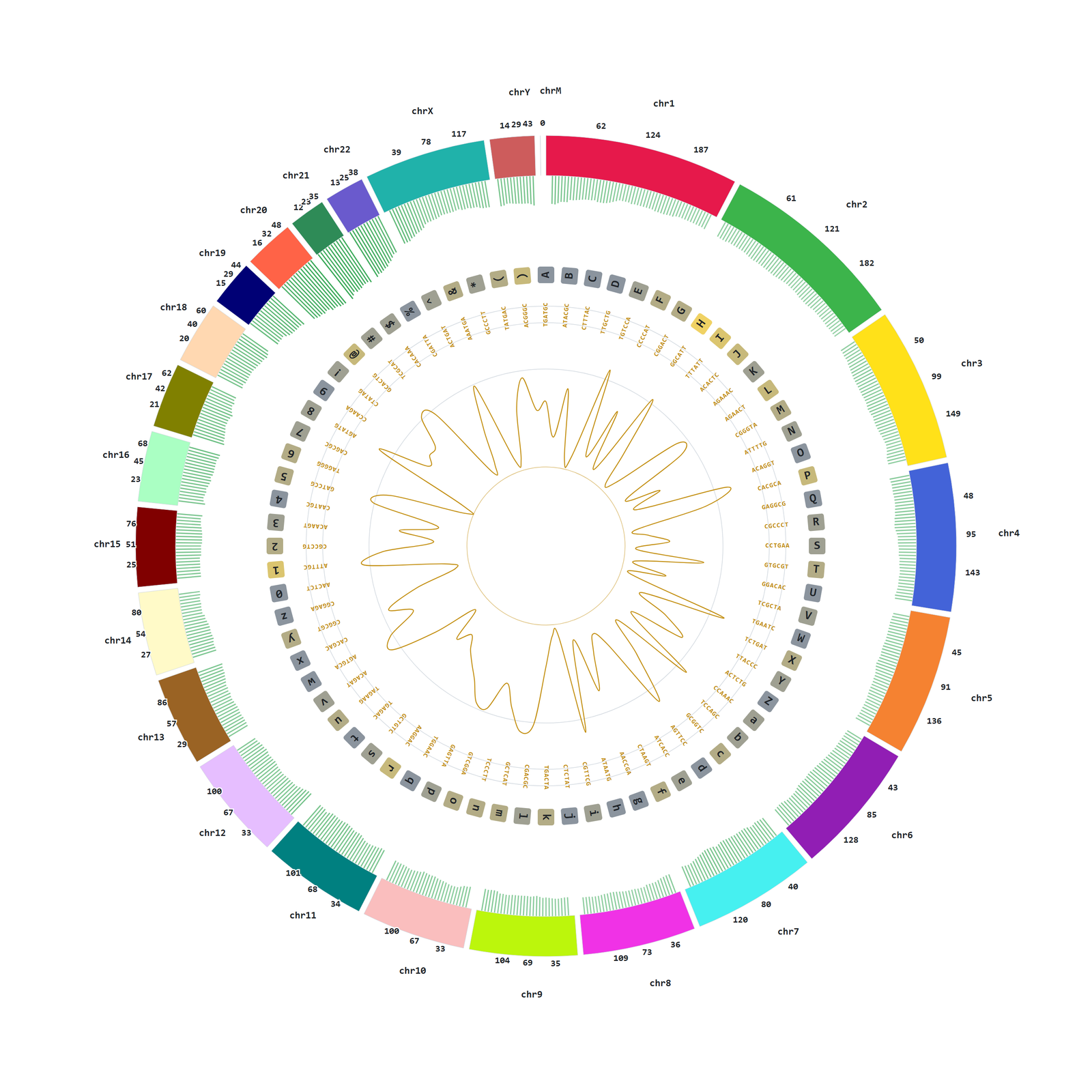
A biological entropy reserve AI and quantum cannot model.
- Only ~5% of Earth's genomes have been sequenced
- The remaining ~95% is a biological entropy reserve
- AI and quantum computers have no training data on the uncharted 95%
- HugeCrypt's genome-guided engine can draw from this space
- Attackers cannot model what they have no data on
- Elite cultivar genomic data is high-value and long-lived — it needs defense that outlasts mathematical trends
- Seed authentication and traceability need cryptographic primitives that are hard to spoof
- Farm-to-market data synchronization needs tamper-evident, authenticatable channels
- Institutional access control needs passwordless, phishing-resistant authentication
- A biological entropy reserve gives a defense posture adversaries cannot fully model
Protecting genomic data of elite cultivars.
Breeding programs and gene banks hold genomic data on high-value cultivars — the intellectual property of future harvests.
- A national germplasm repository's accession metadata and sensitive trait data
- A seed company's unreleased line identities and marker-trait associations
- A breeding program's progenitor genotypes and selection records
- Data that must stay confidential for decades — a cultivar protected today may define harvests through 2050+
- Vault cultivar genomic secret material — provenance records, trait data, unreleased line identities
- Recoverable under the right conditions (vault file + optional PIN), not lost to a single point of failure
- Genome-guided entropy ties protection to biological sequence space — not only to a mathematical key a future quantum machine could derive
- Vault + PIN is a storage-and-recovery layer; the underlying curve defense for public-key material is a separate PQC question
Authentication systems for agricultural institutions.
Breeding programs, field trial networks, and agricultural data platforms need authentication that resists phishing and credential compromise.
- Passwordless authentication built on HugeCrypt
- bcrypt for the hashing primitive — a proven, audited algorithm
- Zero-trust architecture: no persistent raw credential on the server
- PIN-gated recovery adds a user-held factor
- Same vault-and-recover posture as the storage layer
- A multi-institutional field trial network authenticates researchers without passwords
- A gene bank's access control for sensitive accession data
- A breeding program's internal systems for selection and progeny records
- Recovery gated by a vault the researcher keeps — not a password that can be phished
- A stolen vault file is not automatically a stolen credential
Data authentication and synchronization.
Agricultural supply chains generate data across many parties — seedlot records, field measurements, harvest logs, quality assays. They need authenticatable primitives, not just transport-layer security.
- Seedlot records across breeders, multipliers, and certifiers
- Field measurements from multi-location trials
- Harvest logs and quality assays across a supply chain
- Data that must be authenticatable end-to-end, not only in transit
- Tamper-evident synchronization between distributed farm-management systems
- Data authentication — proving a record came from a trusted source and has not been altered
- Synchronization across distributed agricultural systems with authenticatable checkpoints
- Vault + PIN model gives recoverable, auditable secret material that can anchor authentication between parties
- A building block for agricultural data pipelines — not a turnkey supply-chain product
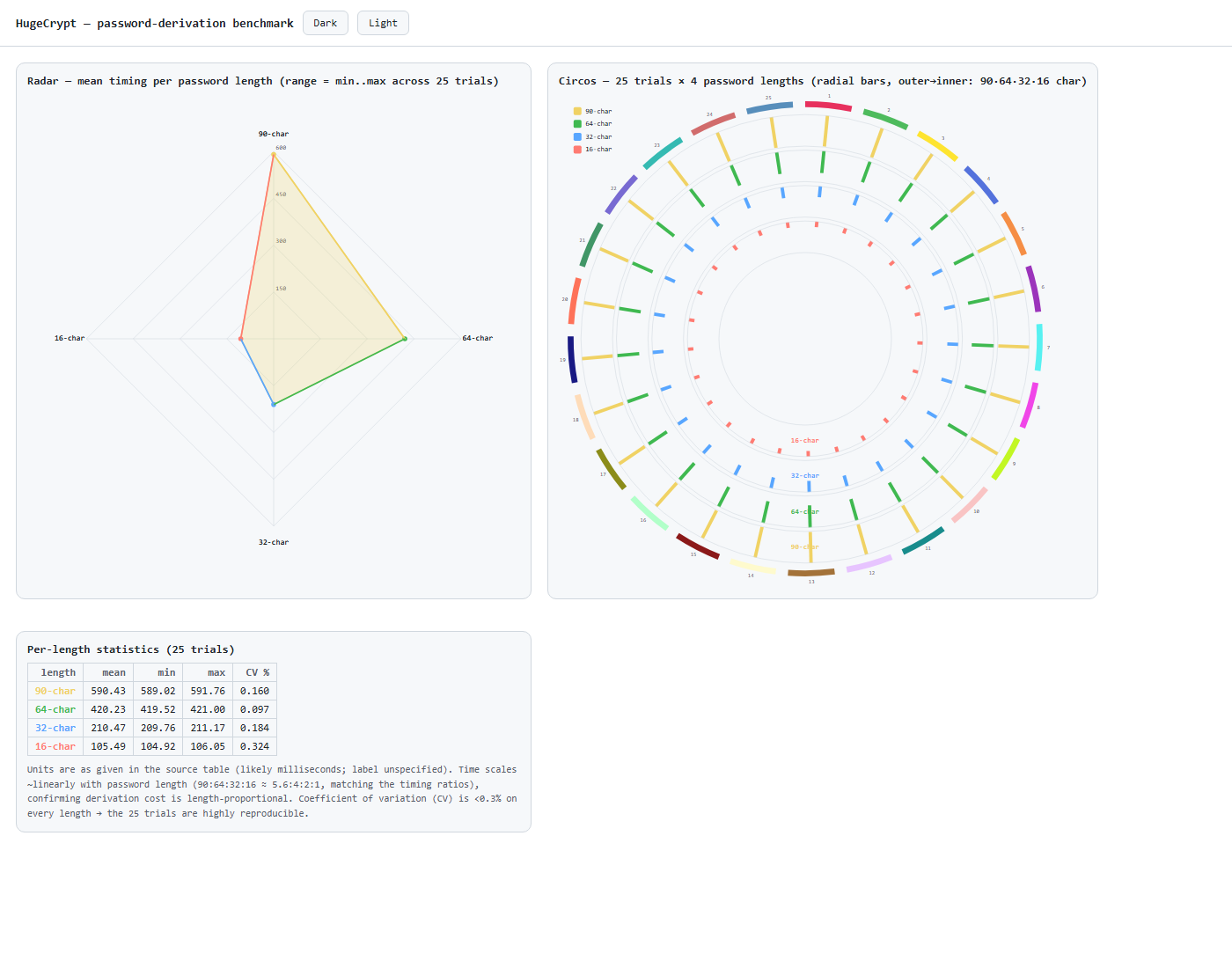
Derivation is reproducible and its cost is predictable.
Benchmark: 25 trials across four input lengths. Mean derivation time scales near-linearly; coefficient of variation is below 0.3% across all trials.
The vault and authentication layers work together.
They are not separate products — they are two faces of the same engine. Every agricultural application above draws on both.
- Create a secret once — shown to you, saved by you
- Pack the recoverable material into a vault file
- Optional PIN changes the recovery path
- Raw secret is not stored permanently on the server
- Vault + PIN (if used) are what you keep
- Passwordless authentication built on HugeCrypt
- bcrypt for the hashing primitive
- Zero-trust: no persistent raw credential on the server
- Same vault-and-recover posture as the storage layer
- Extensible — tailored to different agricultural systems
A research program, not a product pitch.
HugeCrypt is a working engine. The agricultural applications are a research agenda built on top of it. Here are the six directions.
Cultivar genomic vaulting
Genome-guided vaulting for cultivar genomic data — provenance, marker-trait associations, unreleased line identity.
Passwordless institutional auth
Phishing-resistant authentication for breeding programs and field trial networks — bcrypt, zero-trust, PIN-gated recovery.
Data auth & synchronization
Data authentication and synchronization primitives for distributed agricultural data systems — seedlots, field trials, supply chains.
Directions 1–3 are the near-term research agenda — built on capabilities HugeCrypt already has.
The horizon: deterministic recovery, PQC migration, biological entropy.
Three longer-horizon directions that turn the near-term agenda into a sustained research program.
Deterministic recovery
For agricultural secret material that must be bit-identical across recovery runs — cultivar keys, authentication material, sync anchors. Today's HugeCrypt allows small variation for passwords; the deterministic gate is the engineering work.
Post-quantum migration
Moving agricultural systems onto PQC keys when the tooling matures. Vault = rotation and exposure-reduction layer + entropy reserve. PQC = the curve defense. A controlled path, not a rip-and-replace.
Biological entropy reserve
Drawing from the ~95% of genomes not yet sequenced — a biological space AI and quantum have not been trained on. Part of the hardness comes from a space attackers cannot model.
What we are showing at Agrinnovation 2026.
- A working cryptographic engine whose entropy is genome-guided — not purely mathematical
- A demonstration of vault creation, PIN-gated recovery, and passwordless authentication
- Fixed benchmark numbers — reproducible, predictable cost
- Cultivar genomic data protection for breeding programs and gene banks
- Institutional authentication for research networks and access control
- Data authentication and synchronization for supply-chain and field-trial pipelines
Scientific and technical references.
The deck draws on published work in genome-guided cryptography, post-quantum threats to agricultural systems, and the HugeCrypt engine itself.
- HugeCrypt engine — genome-guided secret generation and vault architecture (ChordexBio, internal). Circos visualization framework for whole-genome embedding — Figure 1 derives from this architecture.
- DNAcrypt-AI latent space — synthetic projection of genome k-mer embedding used by the engine (ChordexBio).
- Circos — Krzywinski et al., Circos: an Information Aesthetic for Comparative Genomics, Genome Research (2009). Standard whole-genome visualization framework used to render Figure 1.
- Shor, P. W. — Algorithms for Quantum Computation: Discrete Logarithms and Factoring, Proceedings of the 35th Annual Symposium on Foundations of Computer Science (1994). Basis for quantum attack on RSA / ECC.
- NIST Post-Quantum Cryptography Standardization — selection of CRYSTALS-Kyber / Dilithium family as the PQC migration target for agricultural systems (ongoing).
- AI-assisted attack surface — inference from partial genomic data, credential-pattern learning, metadata and side-channel inference across distributed systems (general security literature; specific agricultural instantiation is part of the research agenda).
Figure 2 derives from the HugeCrypt derivation benchmark — 25 trials per input length, CV < 0.3% across all cases. Full benchmark data and export scripts are in the HugeCrypt repository (infographic/export_bench.py).
Thank you.
Genome-based cryptography for agricultural systems — a working engine and a research agenda.
"HugeCrypt is a working cryptographic engine whose entropy is genome-guided. The agricultural applications are a research agenda built on top of it — not a product pitch, and not a concept waiting to be built."
Questions and collaboration welcome · Agrinnovation 2026 · UPLB