
guntingAI: AI-Driven CRISPR Targetability for Agricultural Genomics
A trainable, annotation-free engine that learns whole-genome CRISPR targetability directly from any sequence — no reference, no gene models, no taxonomy boundary required.
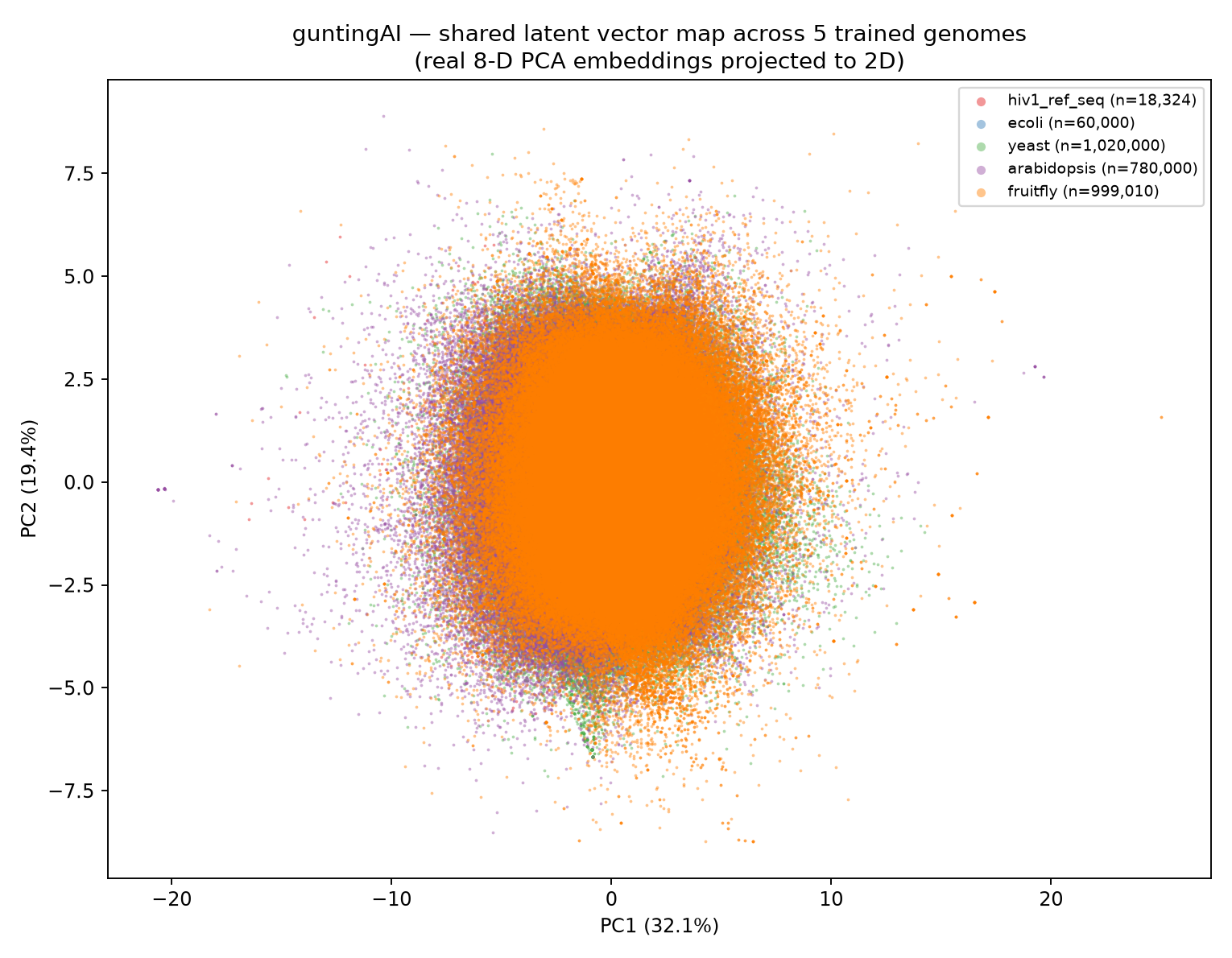 Fig. Shared latent space — PC1 32.1% / PC2 19.4%
The CRISPR Targetability Gap in Agriculture
CRISPR-Cas has transformed crop improvement — but most tools assume model-reference genomes. Over 200 crop species lack high-quality reference assemblies, and Philippine and Southeast Asian germplasm is especially underserved. Existing predictors depend on curated annotation — unusable for draft genomes, metagenome-assembled genomes, and local landraces.
No gene models required
guntingAI scans raw FASTA — no GFF, no curated CDS, no reference annotation. Works on draft assemblies and unannotated contigs.
No borders
No taxonomy, no reference status barrier. The engine learns from any genome collection, including locally isolated Philippine strains absent from global CRISPR databases.
Train once, profile many
Once trained, guntingAI produces a dense targetability map across a whole genome in minutes — not days of manual guide design.
100% of CHOPCHOP targets
On shared benchmark genomes, guntingAI recovers every target independently identified by CHOPCHOP — and additionally finds targets in non-genic regions annotation-dependent tools cannot see.
What guntingAI Does
guntingAI uses an unsupervised representation-learning strategy built on the Covary whole-genome intelligence framework. It sequentially scans a genome, encodes windows into a self-organized, composition-aware feature space, and distills them into reusable learned weights for prediction — trained on viruses, bacteria, fungi, plant, and animal genomes.
- Genome ingestion — any FASTA, any size; fragmented into fixed-length windows with stride
- Composition encoding — k-mer / oligonucleotide spectra projected into the Covary feature space
- Latent distillation — unsupervised representation learning; sequences collapse into a shared manifold across taxa
- Targetability scoring — learned weights assign targetable / designable labels with confidence
- Genome-wide profile — dense targetability map returned; 57% of targetable sites fall outside gene annotations
- Cross-species transfer — shared latent space allows models trained on one taxon to inform related genomes
Scalability Across the Tree of Life
Validated on five benchmarked genomes spanning viruses, bacteria, fungi, plants, and animals — 557.7 million fragments, 22.8 million targetable sites, and 13.7 million designable sites genome-wide.
| Genome | Size | Domain | Targetable Sites | Designable Sites |
|---|---|---|---|---|
| Phage lambda | 48.5 kb | Virus | — | — |
| Escherichia coli K-12 | 4.64 Mb | Bacteria | — | — |
| Saccharomyces cerevisiae | 12.2 Mb | Fungi | — | — |
| Arabidopsis thaliana | 119.7 Mb | Plant | — | — |
| Drosophila melanogaster | 143.7 Mb | Animal | — | — |
Aggregate: 22.8M targetable + 13.7M designable across 557.7M fragments. 13.1M (57%) of targetable sites fall outside gene annotations — discovery space annotation-dependent tools miss entirely.

Unannotated sequence recovery. Across 1,862 unmapped D. melanogaster scaffolds (6.16 Mb), guntingAI recovered 490,466 targetable and 306,538 designable sites — a 4.50% targetable fraction in sequence with no gene annotation.
Latent Space: A Shared Representation Across Domains of Life
The guntingAI latent space is a single continuous manifold hosting viral, bacterial, fungal, plant, and animal sequences together. No hard per-organism boundaries — the model learns composition features conserved across the tree of life, not taxon-specific shortcuts.
- PC1 captures 32.1% and PC2 captures 19.4% of latent variance (combined 51.5%) — a structured, interpretable embedding
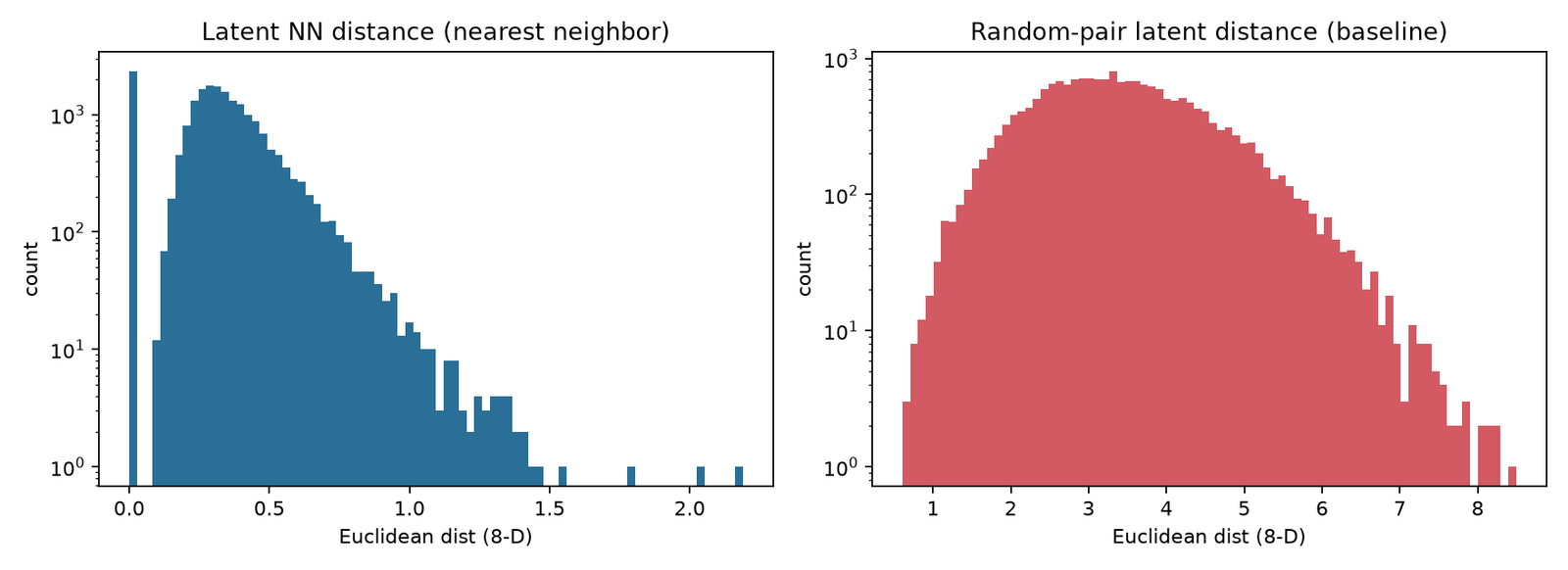
- Nearest-neighbor vs random distance ratio >30× — confirms meaningful representation learning, not random projection
- No per-organism clustering boundaries — sequences from all five kingdoms map into one continuous manifold
- Cross-species transfer foundation — a model trained on one crop genus can inform annotation-free profiling of a related orphan crop
Asian Citrus Psyllid — A Non-Model Agricultural Pest
Diaphorina citri (Asian citrus psyllid) is the vector of Huanglongbing (citrus greening), one of the most destructive citrus diseases worldwide. Its genome was assembled by ChordexBio — a non-model agricultural pest with no curated CRISPR targetability resource. guntingAI scanned the full assembly and produced a genome-wide targetability map.
Vector of HLB
D. citri transmits the phloem-limited bacterium Candidatus Liberibacter asiaticus, the causal agent of citrus greening. No CRISPR targetability resource existed for this pest prior to guntingAI.
Draft genome, full map
guntingAI scanned the full D. citri assembly without requiring gene annotation, producing a dense, genome-wide targetability map with high-confidence designable loci.
Functional genomics + population control
Designable loci support functional gene validation and exploration of population-management strategies for this globally significant citrus pest.
Agricultural Use Cases
guntingAI is built for the realities of agricultural genomics: draft-quality assemblies, orphan crops, and locally important germplasm with no reference annotation.
Trait development
Identify designable CRISPR targets in orphan crops and local landraces without waiting for reference annotation — coconut, banana, mango, rice landraces, abaca, coffee.
Vector functional genomics
Functional genomics in agricultural pests (e.g., D. citri) to validate gene function and explore population-management strategies.
Disease resistance
Rapidly map targetable loci in pathosystems where host or pathogen genomes are draft-quality — no annotation barrier.
Metagenome editing
Targetability profiling on metagenome-assembled genomes (MAGs) from soil, rhizosphere, or microbiome samples.
Collection screening
Profile targetability across a germplasm collection to prioritize transformable lines for breeding programs.
Philippine isolates
Trained on L. fermentum BIL20, L. plantarum BS25, Rhodotorula sp. BUB8 — 3.7M targetable sites from genomes absent from global CRISPR reference DBs.
From Model Organisms to the Field: The Evidence Base
- 557.7M fragments across 5 benchmarked genomes (virus → animal); 22.8M targetable, 13.7M designable
- 57% of targetable sites fall outside gene annotations — discovery space annotation-dependent tools miss entirely
- 4.50% targetable fraction recovered from unannotated D. melanogaster scaffolds with no gene models
- 100% recovery of CHOPCHOP targets on shared benchmarks — guntingAI finds everything standard tools find, and more
- Shared cross-domain latent space (PC1 32.1%, PC2 19.4%) — the representation generalizes, not overfit to a single kingdom
- Philippine-isolate training: 3.7M targetable sites from locally isolated strains absent from global CRISPR reference DBs
What We Are Seeking at AgrInnovation 2026
guntingAI is a deployed engine ready for agricultural partnerships. We are looking for UPLB collaborators to extend the platform into Philippine crop and pest genomics.
UPLB institute collaborations
Partnerships with IB, IPB, CVM, CEA, and other UPLB institutes on crop and pest genomes of national importance.
Philippine crop profiling
Joint profiling of Philippine coconut, banana, mango, rice landraces, abaca, and coffee germplasm with guntingAI.
Use-case pipelines
Co-development of guntingAI pipelines for specific agricultural use cases: disease resistance, trait introgression, vector control.
Local genome access
Access to locally assembled genomes — draft or reference — to extend the guntingAI training corpus.
Domain expert input
Feedback from breeders, molecular biologists, and pathologists on targetability-map interpretability and workflow integration.
Let's talk CRISPR targetability for your crop or pest genome.
guntingAI is a deployed, trainable engine — train once, profile many. We are at AgrInnovation 2026, UPLB, 19–20 October 2026.
chordexbio@gmail.com inquiry@chordexbio.com